OSTTRA becomes a Derivatives Market Institute for Standards (DMIST) ambassador

In response to the FIA’s report calling on participants in the futures and options industry to work together on a major initiative to improve the efficiency of the trading and clearing process for exchange-traded derivatives, we are proud to have become ambassadors of the independent standards body called DMIST in Q2 2022.

As DMIST ambassadors, we will support DMIST’s mission to continue defining solid best practice standards and provide a foundation for the futures industry to improve risk management, increase operational resilience, and grow capacity. This is central to OSTTRA’s objective to be at the centre of the post-trade community and drive the post-trade innovation that is pivotal to industry evolution.

Robert Costick, Director of New Business Initiatives FX & Securities at OSTTRA, explains: “We believe that the cornerstone of this initiative is the propagation of a commonly known Parent Order ID throughout the entire T-zero workflow, to which all subsequent Child Orders are linked and which is recognised by all parties involved in the trade. This Order ID creates an irrefutable link between Executions, Orders and Allocations, ensuring that the right trade will be booked to the right account, at the right clearer, at the right time. At OSTTRA, we have already delivered this Order ID matching capability to production and are now working with a core group of futures commission merchants and investment management firms to advance widespread adoption of this initiative, which we believe will become an integral component of the standards to be set out by DMIST.”

We believe that standardisation will help solve painful inefficiencies in the futures market. As DMIST ambassadors, our team of subject matter experts will help identify, develop, and submit standards to the DMIST Sponsor Board for consideration. By bringing together the people, processes and networks to solve the markets’ most challenging problems, we will help innovate, integrate and optimise the post-trade workflow for exchange traded and cleared derivatives.

OSTTRA for ETDs: Streamlining Listed Derivatives Reconciliation

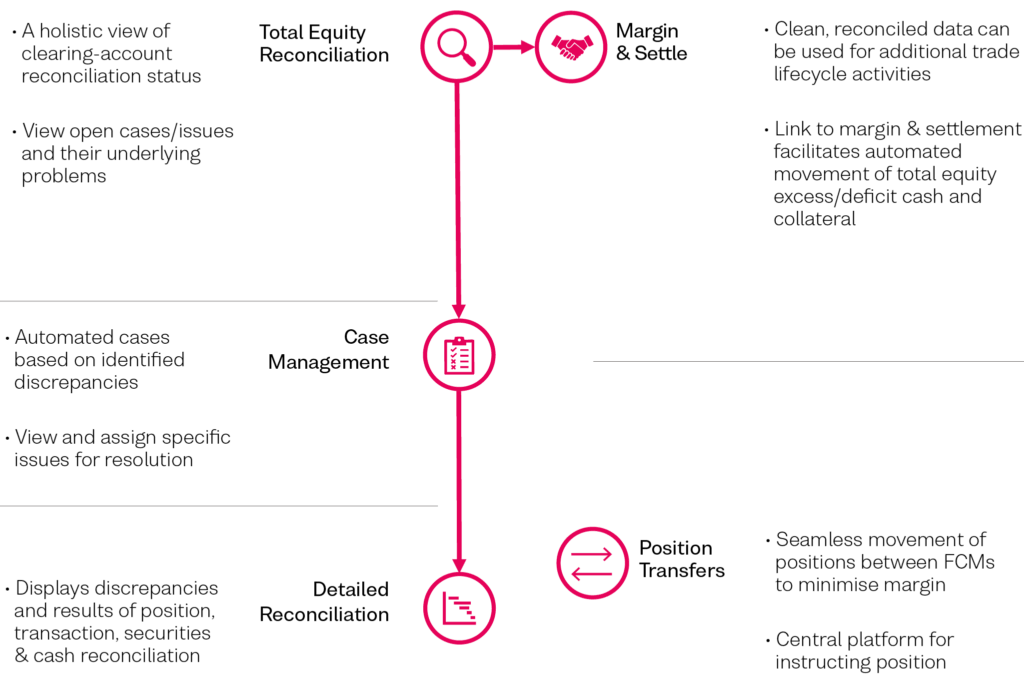
OSTTRA for ETDs provides a comprehensive solution that streamlines the entire trade lifecycle for Exchange Traded Derivatives, from executions and allocations to reconciliation, position transfers, and margin automation.

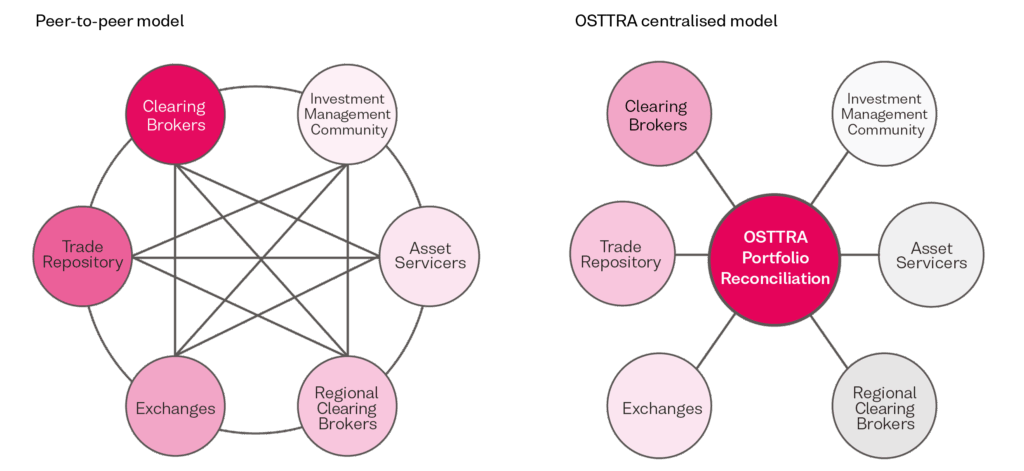
Gain efficiency through a centralised global service where all your counterparties access a shared view. This enables seamless reconciliation and dispute resolution across bilateral/cleared OTC derivatives, Repo, collateral, securities lending, TBA, and exchange traded derivatives (ETDs).


The path to an enhanced total equity reconciliation


A complete solution:

OSTTRA triResolve provides a comprehensive, fully managed service for all your ETD post-trade needs. Simplifying processes from trade capture through to margin settlement, our platform actively manages:


Key benefits


How it works:

Reduce complexity with a single point of integration with all your counterparties: our centralised service model gives you and your counterparties the same view to work together and resolve any differences.

Our automated ETD solution supports reconciliation, dispute management, margin and settlement, all in one place, giving you a single comprehensive view of your clearing accounts. Instantly identify discrepancies, review open cases and track outstanding exceptions, with easy drill-down capabilities to understand underlying problems. We ensure data consistency, conduct thorough position and trade reconciliations, and offer a flexible case management system.

OSTTRA effortlessly scales to your operational volume. For firms managing significant volumes and multiple clearing brokers, we provide an automated reconciliation and sophisticated workflow automation, including proof of cash.

Alleviate operational burdens, improve efficiency, gain critical transparency, and achieve operational excellence with OSTTRA.


OSTTRA and FIS Set to Transform Listed Derivatives Trade Processing

Delivering transparency, standardisation and enhanced connectivity to optimise the ETD post-trade lifecycle

CHICAGO, November 20, 2024 – OSTTRA, the global post-trade solutions provider, today announced a strategic collaboration with FIS® (NYSE: FIS) aimed at bringing new transparency to the exchange-traded derivatives (ETD) post-trade lifecycle.

Through the partnership, the OSTTRA network of investment management clients will benefit from receiving a real-time clearing status from global CCPs via FIS Connections, offering unparalleled transparency into the finality of give-ups and improved exception management capabilities. Meanwhile, FIS will provide the broker network with enhanced operational efficiency via straight-through processing of allocation instructions enriched with OSTTRA order IDs directly into the FIS Cleared Derivatives solution, allowing for increased automation and accuracy in middle office give-up/give-in processing.

Through this collaboration, the two firms will provide rich data insights, enabling market participants to meet the FIA’s Derivatives Market Institute for Standards (DMIST) 30-30-30 standards for the timeliness of allocations and give-ups in the ETD market. This builds on OSTTRA’s pioneering work with DMIST to improve standardisation of ETD post-trade processing.

“This collaboration underscores the commitment of both firms to drive innovation that brings value to all parties of an ETD trade” said Joanna Davies, Managing Director, Head of Trade Processing, OSTTRA. “Together with FIS, we are shaping the future of listed derivatives trade processing, providing new levels of transparency across the ETD post-trade lifecycle.”

Andres Choussy, EVP Group President, FIS Trading and Asset Services, said: “At FIS, we’re delighted to collaborate with OSTTRA to help create an extensive network across buy-side and sell-side participants to optimise the exchange-traded derivatives (ETD) post-trade lifecycle. This collaboration is another proof point of our commitment to unlock capital markets technology to the world and sets a new standard for better collaboration and transparency.”

If you’d like more information on the work OSTTRA is undertaking with the industry to achieve efficiencies in ETD trade processing, please contact us.

OSTTRA and FIA’s DMIST Partner with Key Industry Participants to Establish ETD Post-trade Data Standards

LONDON, 09 March, 2023 – OSTTRA, the global post-trade solutions company and a member of the FIA’s Derivatives Market Institute for Standards (DMIST), confirmed they are working with fellow DMIST members to identify a data standard for post-trade processing of exchange traded derivatives (ETD). Significantly, as part of this process, OSTTRA has provided data & analysis that takes the industry much closer to defining this standard, as detailed in the soon to be released DMIST Annual Progress Report for 2023.

The application of a common data standard is required to increase data quality, create operational efficiency, and reduce systemic risk by minimising breaks on trade date. OSTTRA and DMIST have been working with key industry participants to identify the data set required at five stages of the ETD post-trade workflow, from voice trade recaps to clearing broker booking confirmations, addressing the most persistent causes of trade breaks.

Data and analysis from OSTTRA-led sessions with other DMIST participants has been contributed to DMIST’s data and information working group, resulting in significant progress in defining the data standard, which will support the DMIST draft standard on timeliness currently under review by the industry.  Together, these standards represent a significant step towards increasing efficiency and resiliency in ETD markets.

Don Byron, Head of Global Industry Operations & Execution, FIA, said: “Building on our initial timeliness standards set out in the first phase of DMIST, it’s become increasingly clear that data standardisation is fundamental to completing the transformation of ETD post-trade workflows.  The work is uniting key market participants around a common set of data fields, bringing us closer to valuable efficiencies in ETD markets, as outlined in our recent DMIST annual report.”

Joanna Davies Head of FX and Securities, OSTTRA, commented: “The persistence of common data fields is the key to unlocking efficiency in the current ETD post-trade workflow. This data standard is the clear next step on the roadmap for evolutionary change in ETD processing and illustrates further industry collaboration around the DMIST initiative. We will continue to work within the FIA DMIST framework to refine the dataset that will contribute to the core requirement of any suggested standard.”

Samina Anwar, Global Derivatives Operations Director for Cargill added: “The adoption of common data fields in ETD is the next step toward reducing hedging risk through data standardisation for voice trading. We’re delighted that market participants are working together to reach this milestone, which presents real practical progress in the effort to foster cross-industry engagement on the DMIST 30/30/30 standard.”

If you’d like more information on the work OSTTRA is undertaking with the industry to achieve efficiencies in ETD trade processing, please contact us.

OSTTRA to provide real-time visibility of Eurex exchange-traded derivative trade status

NEW YORK, LONDON, 18th January 2023 – OSTTRA, the global post-trade solutions company, is enhancing its network to give market participants a real-time view into the status of Exchange Traded Derivative trades being cleared through Eurex.

The enhanced connectivity will enable Eurex to send investment managers booking confirmations for their allocations via OSTTRA ClientLink for ETD, delivering live status updates on which trades have been given up, claimed and cleared – providing trade certainty in fast-moving markets.

Eurex Clearing plans to become the second central clearing counterparty (CCP) after the CME to connect to OSTTRA ClientLink for ETD, the post-trade network of close to 200 market participants. Real-time information on trade status is increasingly important in futures markets as more frequent volume spikes create bottlenecks in processing flows. A third CCP is close to completing connectivity to the network and more are lined up for delivery in 2023.

OSTTRA has also worked closely with Eurex on an additional project to enable clients to manage the Next Generation ETD Contracts currently under development by Eurex and scheduled to go live in March 2023. OSTTRA ClientLink for ETD users are already able to test the new functionality.

“We are pleased to support vendors like OSTTRA to deliver much needed transparency to all parties on the trade,” said Melanie Weber, SVP Derivatives Clearing Design, Eurex Clearing. “By receiving real-time updates, clients will be able to manage operational risk and capital more effectively throughout the trading day.   In parallel to the ETD transformation initiative, OSTTRA and Eurex Clearing are aligned on the Next Generation ETD Contracts, which Eurex is implementing to allow more than one expiration per month under a single product ID, providing clients with additional flexibility.”

“The ETD industry needs greater visibility and efficiency as demonstrated by the ongoing commitment of industry participants to the FIA DMIST standards development. In the past, volumes would increase as a reaction to significant macroeconomic events. Now, every month, we are consistently seeing volume spikes, thus urgently increasing demand for a real-time solution that provides a window into every aspect of the give up and allocations workflow”, added Joanna Davies, Head of FX and Securities, OSTTRA. “The ability to support the entire ETD community with this new flexibility and transparency presents a huge leap in the evolution of both the ETD trade allocation process and the transformation of the ETD workflow.”

OSTTRA – The home of MarkitServ, Traiana, TriOptima and Reset, OSTTRA (www.osttra.com) brings processes and networks together along with expertise to solve post-trade challenges in the global financial markets. OSTTRA strengthens the post-trade infrastructure and ecosystem with robust end-to-end post-trade solutions and unrivalled connectivity.


From Rusty Bikes to Formula One: Upgrading Cash Flow Management in Derivatives Trading

Traditionally, the back office has lagged behind the front office in technological advancements, hindering efficiency and accuracy in cash flow management. It’s time to shift gears and unleash the full potential of automation, regardless of asset class or payment type.

In December 2024, Philippe Lintern, the head of the Bank of England’s FX division, compared front office staff using the most advanced technology to Formula One teams, while noting that peers in the back office were left struggling to match the pace on their “rusty old bicycles.” An area where this rings particularly true is the $667 trillion global derivatives space, where cash flow management remains heavily manual, relying on humans, emails and even fax machines, despite the fast-paced world of trading pushing ever increasing volumes through this strained back office infrastructure.

It doesn’t have to be like this. As the dust settles from the all-consuming rush to T+1 settlement, resources can be re-focused on tackling some of the stubborn pockets of manual process that persist in the back office – and with the twin goals of improving both operational and capital efficiency, cash flow management is emerging as a priority.

“Last year we started to see a lot more focus on transparency and automation in post-trade interactions between counterparties, including those processes where custodians are involved, such as cash flow payments,” said Tom Woolfenden, Director, Product Design, OSTTRA. “However, so much manual coordination remains to agree and settle these cash flows.” This has been highlighted recently by the Financial Markets Standards Board in their final standard for sharing of Settlement Instructions, and updated guidance also issued in the Global Foreign Exchange Committee’s revised FX Global Code, such as Principle 44, which states that “Market Participants are encouraged to implement straight-through automatic transmission of trade data from their front office systems to their operations systems”, by means of secure interfaces where the transmitted trade data cannot be changed or deleted during transmission.

Cash flow management itself isn’t a complicated concept: At its core, it’s about making regular payments to the other parties involved in your trades, based on the underlying contract terms and up-to-date valuations.

However, things get incredibly complex when you consider the scale of the market. A large financial institution might handle hundreds of thousands of these trades and their associated cash flows every month. This volume alone makes it difficult to track who owes what to whom. The problem is compounded by the fact that different participants use different data standards, calculation methods, market data sources, and messaging formats. This lack of standardisation can make it extremely challenging to even figure out which specific trade back-office staff are discussing in their emails, or which trade is causing a discrepancy.

“An absolute worst-case scenario is that you’re expecting to receive a cash flow from an open trade, and you have your designs on how to use that money, but your counterparty doesn’t even have an idea that there is an obligation to you”, Woolfenden adds.

Interest rate swaps, equity swaps and portfolio swaps are prime examples of the products where manual cash flow management leads to errors and operational inefficiencies. Take equity swaps for example: Cash flow management for these contracts involves the ongoing payments of the swap for the duration of the trade, as well as the underlying dividends and accruals, all of which need to be calculated, agreed on and then settled, which is where the uncertainty and misalignment comes in.

“We often see market participants taking agreed cash flow information offline, emailing, or even faxing it to their custodian, creating an inefficient communications chain to complete the payment and settlement process,” Woolfenden said.

As settlement times are expected to continue to shorten globally, untangling the confusion will quickly become even more important. Cash flow inefficiencies also prevent liquidity optimisation, or the ability of the front office to deploy cash to generate profits – because the money is stuck in a back-office limbo until the disagreement is resolved.

The most efficient way to resolve this conundrum is bringing transparency into the process for all sides and linking agreed trades with subsequent cash flows so that calculations can be made using consistent economics. OSTTRA Cash Flow Management is an established platform that helps streamline the cash-flow-processing challenge with a standard workflow and matching engine. With legal confirmations for many bilateral OTC trades readily available on OSTTRA MarkitWire and connected to the OSTTRA triResolve reconciliation engine, participants can have complete confidence that they share a common view of a transaction with their counterparties. An automated system that matches cash flows, as well as linking the underlying trades associated with them, removes the need to spend time figuring out who owes what and why: OSTTRA Cash Flow Management also notifies participants if they’re misaligned. It can also bilaterally net matched cash flows into an agreed, reduced number of payments whilst respecting settlement instructions.

“At OSTTRA, we are uniquely positioned to eliminate friction and inaccuracies in derivatives cash flows, thanks to our position at the centre of post-trade, from trade confirmation and processing through to portfolio reconciliation and collateral management, and all the opportunities for improving data standardisation that this brings. The end result is that we can seamlessly automate the entire process, including sending SWIFT settlement messages on behalf of our clients. The settling bank, typically the custodian, can receive an instruction to do the settlement just one minute after the cash flow is matched, removing the all too common merry-go-round of email, phone and fax communication and bringing greater transparency on a real-time basis,” Woolfenden said.

Once the whole lifecycle is automated, conducted in real-time and in a way that’s transparent to parties, calculations can be done on the same basis, payments can be netted and settlement becomes a matter of a simple instruction to the custodian – as easy as riding a bike! To learn more about OSTTRA for Cash Flow Management, please visit osttra.com/cashflow


From T+1 Settlement to the FX Global Code: Unlock Operational Excellence in Post-Trade

Are you ready to elevate your post-trade operations in the face of evolving regulatory demands? T+1 settlement, CSDR, and the FX Global Code are setting new standards for operational excellence, demanding proactive solutions.

Listen as Steve French, Commercial Head for FX & Securities at OSTTRA, discusses how new regulations, industry initiatives and volatile markets are increasing demands for operational resilience and agility.

Beyond DORA: Building a Foundation for Lasting Operational Resilience in Post-Trade

The DORA deadline on the 17th of January 2025 is a critical milestone for financial firms operating in the EU. But achieving true operational resilience goes beyond headline risks like cyber risk and checking boxes for compliance. It requires a proactive and holistic approach that anticipates and mitigates a wide range of potential disruptions.

In this video, OSTTRA experts go beyond the immediate demands of DORA to explore the broader landscape of post-trade operational resilience. They discuss:

Actualización de Servicios del Ciclo de Vida de las Operaciones – Invierno 2025

El 2025 ha sido un año de avances importantes en la conciliación de garantías y carteras, y nos complace compartir algunos de los aspectos más destacados. De cara al 2026, nos comprometemos a seguir brindando a los participantes del mercado herramientas que simplifiquen los flujos de trabajo, reduzcan el riesgo, optimicen el procesamiento de márgenes y faciliten el cumplimiento de nuevas regulaciones.

Trade Lifecycle Services Update – Winter 2025

2025 has been a year of significant progress in collateral and portfolio reconciliation, and we’re thrilled to share some highlights. Looking ahead to 2026, we’re committed to further empowering market participants by simplifying workflows, reducing risk, optimising margin processing, and facilitating a seamless adoption of new regulations.

Services