Trade novation to support Asset Manager merger

Client type: Global Asset Manager


Challenge:

Following the completion of an asset manager merger, Custom Processing was approached to facilitate the transfer of selected funds and associated bilateral trades on OSTTRA MarkitWire and OSTTRA Trade Manager


OSTTRA Solution:

Following a review of the scope of work, the asset manager leveraged the Custom Processing team to handle all activities pertaining to the novation of trades across OSTTRA MarkitWire and OSTTRA Trade Manager


OSTTRA Delivered:


Customer Benefits


Focused, Tried and Tested


For more information or to arrange a call with a member of the Team please email info@osttra.com.

Novation and backloading of 70,000 trades for G15 bank restructure

Client type:  G15 Bank


Challenge:

Following internal restructuring, a G15 bank approached Custom Processing to facilitate the novation and backloading of bilateral trades across OSTTRA MarkitWire.


OSTTRA Solution:

Following a review of the scope of work, the G15 bank leveraged the Custom Processing team to handle all activities pertaining to the novation and backloading of trades across OSTTRA MarkitWire


OSTTRA Delivered:


Customer Benefits


Focused, Tried and Tested


For more information or to arrange a call with a member of the Team please email info@osttra.com.

OSTTRA transfers $190 billion of open interest to support the ICE Clear Europe credit clearing closure

London, 04 May 2023 – OSTTRA, the global post-trade solutions company today announced that its counterparty risk optimisation service, OSTTRA triBalance, has successfully completed five of a series of rebalancing cycles, reducing open interest and moving residual positions to alternative clearing houses ahead of the closure of the CDS clearing service at ICE Clear Europe later this year.

OSTTRA delivered a reduction of more than $190 billion equivalent in open interest in Indices and selected Single Name CDS at ICE Clear Europe, approximately 50% of the Indices and between 85% and 98% of Telecom, Technology, Utilities, Basic Materials, Energy, Healthcare and Consumer Goods and Services Single Name CDS positions were closed out.

These results are particularly impressive given that approximately 35% of the index open interest in scope of the closure was in instruments that are subject to regulatory restrictions. As of 30 March, regulators1 have provided a time-limited exemption, to allow for the inclusion of the instruments that were previously restricted, until the closure of the CDS clearing service at ICE Clear Europe, to aid firms with the risk moves.

Following ICE Clear Europe’s decision to exit the CDS clearing business, market participants need to migrate their positions from ICE Clear Europe to either ICE Clear Credit or LCH SA.

With a central role in post trade workflows for credit derivatives, OSTTRA is uniquely placed to support the industry in a robust, cost-efficient and timely transition. The solution combines the extensive risk transfer and optimisation capabilities of OSTTRA triBalance, with trade processing via OSTTRA MarkitWire and TradeServ to ensure new positions are accurately reflected at CCPs and in the Trade Information Warehouse.

“In collaboration with market participants and OSTTRA, ICE Clear Europe has reached an important milestone in the work towards the cessation of its CDS clearing service,” said Hester Serafini, President of ICE Clear Europe. “The compression service allows market participants to smoothly migrate their CDS positions and the first cycles have been very successful. We look forward to future iterations over the coming months.”

“We are delighted with the results of the transition cycles, providing market participants with an innovative solution to manage an orderly exit. The open interest reductions achieved, and the smooth running of the whole process demonstrate the value that OSTTRA can deliver, contributing to the smooth and efficient running of the credit derivatives market” concluded Erik Petri, Head of OSTTRA triReduce & triBalance.

To find out more, talk to a member of our team at at info@osttra.com.


1The time limited exemptions can be found here CFTC, FCA, ESMA.


From Faxes to Fintech: OSTTRA MarkitWire – Reflecting on 20+ years of industry evolution

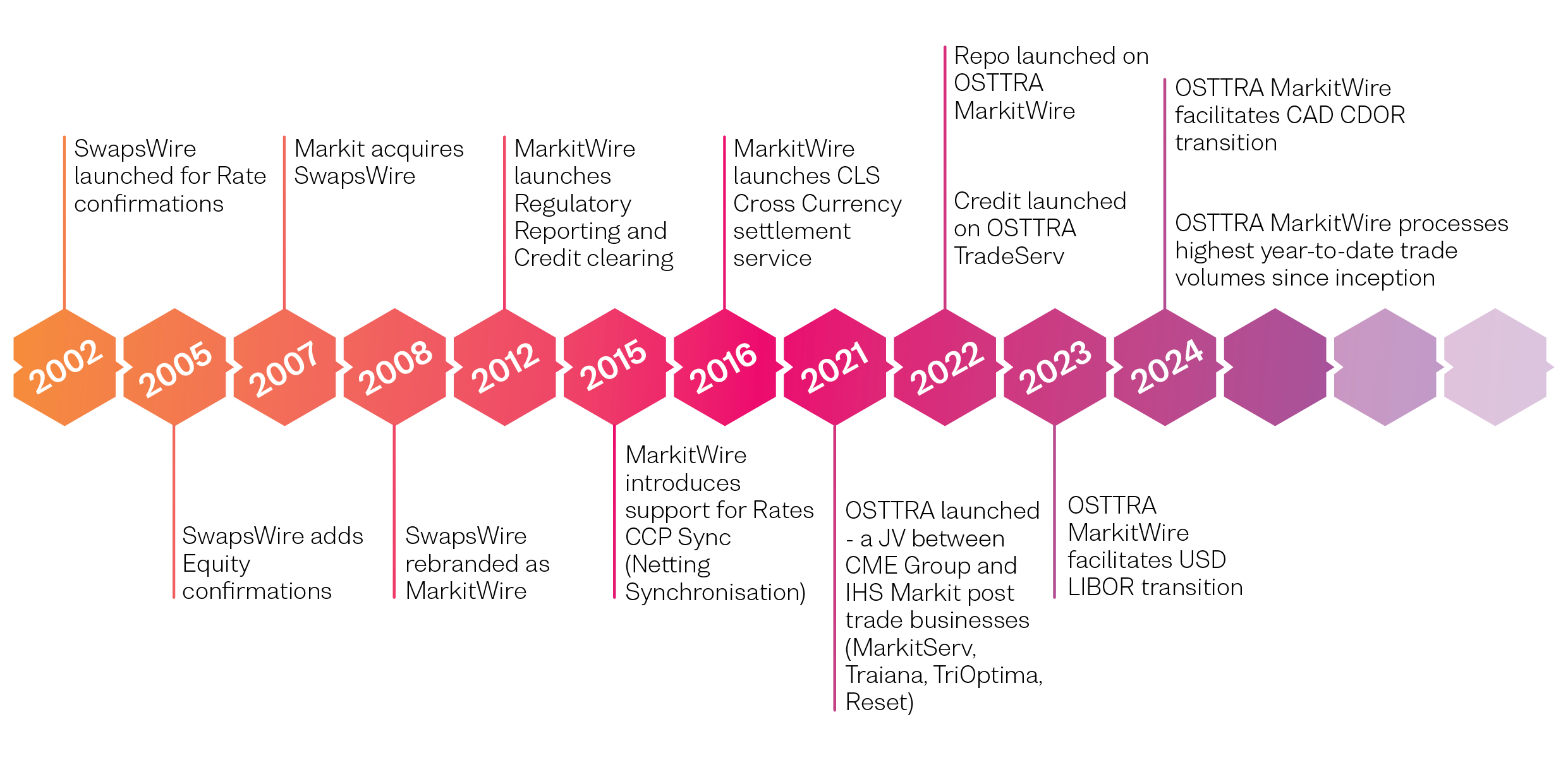
The financial markets have undergone a dramatic transformation in the past two decades, and OSTTRA MarkitWire has been at the forefront of this evolution. From its origins replacing fax-based confirmations to its current role as a leading fintech platform, OSTTRA MarkitWire has helped shape the post-trade landscape and actively participated in the evolution.

Momentous change in financial markets

Looking back, the sheer magnitude of change is striking. Gone are the days of cumbersome manual processes, when boxes of derivative confirmations were couriered to counterparties to agree trades, or trade records were faxed over archaic technologies. Today’s seamless electronic post-trade processes have come a long way, driven in part by new technology but also by market events. And while not all those events have been anticipated or welcome, the challenges they presented have spurred innovation and ultimately benefited the entire industry. The ramifications of the global financial crisis have shaped much of today’s over-the-counter (or OTC) derivative trade workflows. Legislation has been passed and successfully rolled out across market jurisdictions.

Reflecting on the past twenty years, we feel it’s essential to pause and appreciate the industry’s remarkable evolution and accomplishments, and the role OSTTRA MarkitWire has played. But the journey doesn’t end here. OSTTRA remains committed to partnering with clients to navigate the challenges and opportunities that lie ahead. Synergies across the OSTTRA business mean clients will have single streamlined workflows across large data sets; a marked difference to a past world of siloed interactions.

20 years of evolution

The story of post-trade processing is a journey of evolution, driven by technology vendors but guided by financial institutions. In the early days of SwapsWire, the original name for OSTTRA MarkitWire, the focus was on building a platform that could connect counterparties for electronic trade confirmation in the interest rate derivatives market and then quickly progressed to support clearing. This marked a significant step forward from the manual processes that dominated the industry.

Since then, the service has evolved into a comprehensive platform driven by straight-through processing (STP), significantly reducing operational risk by minimising human intervention. Today it comfortably processes tens of millions of trade records yearly, supporting rates, credit, equity, and repo transactions across 34 currencies and various product sub-types, with connectivity to 12 CCPs and multiple venues supporting 8 venue types. Building on this success, OSTTRA MarkitWire is transforming the bilateral repo market with our standardised, automated affirmation and confirmation workflows, while working with our customers to prepare for the incoming clearing mandates in the United States.
Furthermore, OSTTRA Trade Manager interacts seamlessly with OSTTRA MarkitWire providing investment managers and fund administrators with a consolidated matching and confirmation workflow across asset classes.

OSTTRA MarkitWire has a proven track record of supporting the industry through periods of significant change and uncertainty. When the Lehman Brothers crisis emerged in 2008, we worked with our clients and clearing houses to assist in an orderly transition of portfolios. The partnership has continued through the rollout of clearing best practices and mandates worldwide with OSTTRA MarkitWire connectivity extended to relevant CCPs, not only for clearing but also for post-clearing events, including the cleared trade IBOR transitions. The service now includes CLS settlement and connectivity to trade repositories for regulatory reporting.

In this era of complex and intense regulatory debate, OSTTRA has remained a steadfast partner, providing clients and partners with automated, digitised solutions, helping to manage the cost and complexity of change.


Consensus building – the keystone for centralised adoption

One of the most important roles a scaled technology provider can play is to act as a forum for rational industry-wide decision making. The industry expresses its mutual needs, and we provide intelligence, expertise and insight on how workflows can evolve to satisfy new regulations efficiently.

Market participants can struggle to collaborate and find cost-effective solutions to benefit the industry without setting off legal alarm bells. We have provided a safe forum for discussion since the initial launch with a member group of 23 businesses interested in standardising inter-dealer messaging in the rates market. Today we engage with a network of over 1,600 active participants across multiple working groups and the network continues to grow, particularly in emerging markets where the demand for market infrastructure increases.

With our partners we have taken the industry on a journey, drawing on new technologies and techniques as they have become available. That journey is not stopping now; on the contrary, OSTTRA marks a shift into a new gear, with the promise of compelling and synchronised benefits to our customers.

Marrying ‘T0’ and ‘T+’ post-trade processes

As OSTTRA, we have aligned our services to enable frictionless workflow for confirmation and reconciliation processes. Our full legal confirmation remains the key cog in our credit, rates and equity businesses – providing a golden source of agreed electronic derivative contract information to market counterparties, and creating a point of agreement and standardisation that enables trust.

Using this record in downstream T+1 activities lowers the resource burden for operational teams managing increasing volumes and system complexities. In today’s environment of ever-increasing regulatory scrutiny, banks must conduct assorted reconciliations across their technology infrastructures to ensure data accuracy and compliance. This includes reconciling data between their own global business units, between counterparties, with clearing houses and also the data they report to trade repositories.

Given OSTTRA’s interconnected post-trade services and 20 year track record, we are uniquely positioned to assist the industry in navigating these processes. This is our bread and butter. Increasing STP, harnessing the power of data, enabling synchronised analytical processes and allowing customers to optimise their resources most appropriately aligns with our vision and track record of marrying post-trade processes for the benefit of the industry.

In delivering for our clients i.e., by connecting OSTTRA MarkitWire and our portfolio reconciliation service, OSTTRA triResolve, we endeavour to add further use cases that bridge the synergies within OSTTRA. Future cases will span different asset classes and platforms, amplifying the resource optimisation benefits our customers are continually searching for and removing redundant processes for good.

Partnering with the industry through Interest Rates reform and transition

Financial market professionals will be well-versed with the global introduction of overnight risk-free rates (RFRs), replacing legacy interbank offered rates (IBORs), across multiple markets and currencies. For over 20 years the legacy OSTTRA businesses have helped navigate industry change like central clearing, regulatory reporting, compliance timeliness, and disclosure of material economic terms (METs). Benchmark reform is no different.

OSTTRA MarkitWire’s CCP Sync services for Rates initially focused on netting, compression, and portfolio transfers. By listening to multiple CCP updates and absorbing trade messages back into customer systems via existing APIs, we enabled advantageous STP workflow and mitigated the need for customers to build additional post-trade connectivity. As clearing continues to evolve across various jurisdictions, this connectivity remains as important as ever.

Enter benchmark reform through clearing events – the process of running high-risk, multi-year projects of transitioning millions of trades from IBOR rates to new RFRs. Using our CCP Sync service, hundreds of customers have avoided expensive ‘blue ocean’ builds and instead utilised the OSTTRA MarkitWire connectivity to multiple CCPs and coverage of key market currencies, to achieve transitions in an automated manner. We partnered with the industry through the initial IBOR transitions in 2021 and the notable USD Libor transition events in 2023 – the work continues today.

As various markets and regulators continue to review and update legacy rates – most recently Canada, and looking ahead to Mexico, Japan and Israel – rest assured the OSTTRA team is on-hand to deliver exceptional CCP Sync services that reduce cost and risk through low latency and resilient frameworks. We have no doubt legacy rates will remain in certain markets, and that’s OK; our aim is to partner with the industry across their broader portfolios of trades, be they cleared or non-cleared, and when the time is right, we’ll be there to support rates transition activity.


It’s not about the destination, it’s about our journey together

So the question is, where does the industry go from here? With a backdrop of exciting new technologies such as distributed ledger and artificial intelligence (AI), our experts are naturally following these developments and applying innovative and incremental changes to our products, for example, OSTTRA Trade Manager’s Paper Digitisation module. We view these changes as natural improvements to the existing products that have served the industry so well.

Most importantly, we look to our clients to shape our functionality roadmap. Their input may be driven by technology, the pursuit of greater operational efficiency, or challenges arising from new ideas or regulatory and compliance needs. Whatever the use case, we are committed to working collaboratively with the industry. We are not in the business of advocating shiny new technologies for their own sake, our philosophy is to advance the needs of the industry, building on 20 years of connectivity, evolution, resilience, partnership and transparency.

Two decades of experience have prepared us for the next chapter of post-trade. We’re embracing the challenge and the technology, collaborating with our clients to build a future defined by efficiency, innovation, and connectivity. The future is post-trade, and it starts now.

For more information, contact info@osttra.com

Post-trade Processing: The Next Horizon

In the second of a two-part series, Michael Wilshere, Commercial Head of FX and Rates Trade Processing at OSTTRA, discusses the changing shape of post-trade and how market demand is shaping future innovation on OSTTRA MarkitWire and beyond

Like many parts of the financial services ecosystem, the early mechanics of post-trade were characterised by siloed services, manual processes and clunky technology. Faxed trade records and couriered derivatives confirmations were commonplace. Today, however, the post-trade landscape looks very different, driven by the push and pull of regulatory change and client demand.

OSTTRA has played a key role in driving transformation and helping firms adapt. Its offerings span multiple asset classes and steps in the post-trade lifecycle – from trade capture and confirmation, through portfolio reconciliation and margin management, to risk and capital optimisation. At the heart of the firm’s network is the OSTTRA MarkitWire trade processing platform, which has been evolving continuously for more than 25 years to streamline and automate rates and equity derivatives trade workflows.

Michael Wilshere outlines some of the key innovations that are shaping the future of post-trade processing.

 

As a starting point, could you outline some of the key trends you’re seeing in the over-the-counter (OTC) derivatives space today, and where you’re seeing growth in demand for post-trade services?

If we look at the more established markets, customers in the UK, Europe and the US are still balancing regulatory compliance with the drive for frictionless trade, especially given current market volatility arising from elections, macroeconomics and trade policies. They’re looking to providers like us to resolve breaks, disputes or connectivity issues.

We’re addressing this by introducing functionality in the cleared and non-cleared spaces. For example, packaged trade functionality in clearing ensures all trade legs are processed (cleared or rejected) simultaneously. And, in the non-cleared space, we are focusing on matching accuracies, such as where breaks occur in date conventions or where there are different accounting conventions on the trade.

In emerging markets, we’re seeing different trends. Clients there are looking to move into the centralised networks we provide to benefit from our products, workflows and functionality. Additionally, they require nuanced local market solutions, such as moving their paper workflows to electronic templates. We’ve introduced currency support in the Middle East – Saudi Arabia and the United Arab Emirates – and, this year, we’re working with customers in Latin America to introduce inflation-based swaps in Chile. Advocating for the move from manual to electronic processes remains a key theme for this segment.

More broadly, we’re partnering with upstream venues, downstream clearing houses and regulatory jurisdictions to ensure customers benefit from efficient end-to-end workflows.


From the Basel Committee on Banking Supervision reform to the interbank offered rate (IBOR) transition, regulatory change has played a key factor in the evolution of post-trade services. Which initiatives do you expect to exert the greatest influence over post-trade requirements in the next five years?

The IBOR transition and Basel benchmark reform have driven much of the activity over the past six or seven years. This has brought new risk-free rates into the post-trade landscape, impacting bilateral matching, confirmations and cleared workflows. OSTTRA MarkitWire plays a crucial role by integrating updates from central clearing parties during these transitions and seamlessly feeding new trades to customer risk
systems.

That activity peaked in 2023 with the US dollar Libor migration to the secured overnight financing rate (SOFR), but the momentum continued last year with Canada’s migration to the new Canadian overnight repo rate average (CORRA), as well as Mexico’s switch to the TIIE de Fondeo rate.

These reforms are progressing in established and newer markets, with ongoing medium-term activity. This year, for instance, we have had clearing house activity and transition events in Israel, and there is active interest from local markets such as Denmark, the Czech Republic and South Africa. Over the past five years, OSTTRA has facilitated the move to risk-free rates in around 15 markets, while OSTTRA MarkitWire supports more than 30 currencies and regional markets. There’s a runway for further activity, helping clients with those transitions.

One other item worth highlighting – which has driven a lot of activity in the past 12 months – is enhancing transparency around regulatory reporting. In the first half of 2024, we assisted customers with supporting unique product identifier processing for regulatory reporting, particularly in North America for the Commodity Futures Trading Commission and Canada.

Subsequently, we supported numerous customers with regulatory rewrites, adding new fields and tags for European reporting – the UK Financial Conduct Authority and the European Securities and Markets Authority. And, in late 2024, Asian authorities – the Australian Securities and Investments Commission, as well as the Monetary Authority of Singapore. Again, that will continue in the short and medium term.

Even now, this focus on reporting clarity continues, with current work including updates to Canadian regulatory reporting requirements for several swap execution facilities.
 

What are the main challenges facing market participants in the current environment? And how has OSTTRA MarkitWire evolved to meet client needs in these areas?

Starting with the bilateral cross-currency space, we’ve certainly seen a lot of customers looking to move the matching and confirmations workflow closer to the settlement cycles. This is primarily driven by tighter settlement timing thresholds, the T+1 initiative and updates to the FX Global Code of Conduct. Our cross-currency connectivity service, which extends to settlement agencies and banks, has been expanding to meet this demand, and we’ve seen that underlying network grow significantly in recent years. The challenge is to bring matching and confirmations closer and more aligned with settlement, streamlining two workflows into one.

Beyond cross-currency swaps, swaptions are presenting increasing use cases. These are complicated products that can take some time to process. We’re introducing enhanced functionality and are working closely with leading investment firms and trading venues. The goal is to connect historically confirmed or matched options and provide this information back to the venue when these firms execute new transactions. Viewing these trades enables firms to flatten existing risk or strategically create new risk.

On the clearing side, there’s a strong emphasis on finding the best clearing models for the US Treasuries market, despite the extended deadline for clearing cross repo and cash instruments.

From OSTTRA’s standpoint, while it is not for us to dictate what types of models are adopted, we do want to provide valuable insights and awareness to customers as they transition to these new clearing workflows. This approach is informed by our experience assisting numerous market participants with the OTC swap clearing implementation under the Dodd-Frank Act approximately a decade ago.

We’re achieving this through contributions to industry working groups, speaking to trading venues, clearing brokers, clearing houses, and so on. In terms of solutions, our credit limit check service – OSTTRA LimitHub, already used by clients for interest rate and credit default swaps – offers significant potential value for the treasury clearing space.


“There’s a strong emphasis on finding the best clearing models for the US Treasuries market, despite the extended deadline for clearing cross repo and cash instruments.”

– Michael Wilshere, OSTTRA


A previous Risk.net article, From faxes to fintech, mentioned OSTTRA’s desire to collaborate with clients to build a future defined by “efficiency, innovation and connectivity”. Can you provide examples of where OSTTRA is delivering on this ambition?

Considering the volume of rates workflow that is cleared, we’re very much focused on our clearing network when it comes to connectivity, so I’ll start there.

Currently, we have connections to 12 central clearing counterparties, and we’re looking to enhance that through packaged clearing, which is being rolled out in conjunction with industry partners.

We’re also speaking to newer clearing houses to bring them into the network, giving clients more optionality. We signed a memorandum of understanding a few months ago with Muqassa in Saudi Arabia – our first clearing house in the Middle East – offering access and workflow solutions across emerging markets.

Further downstream, within our lifecycle events, we have a reconciliation tool called OSTTRA triResolve. When customers look at reconciliations, they are always referring back to the principal trade confirmation or trade match. That’s available through our trade processing services, within rates, on OSTTRA MarkitWire, so we have connected the reconciliation process to the platform. We’ve completed this with more than 150 customers – there’s a lot of demand – and we’ll continue to look for ways to make post-trade markets more efficient.


Post-trade services are sometimes viewed as an unavoidable cost to the bottom line. How can firms maximise value from their investments in this area?

I’d agree, but there are examples where I think we are providing a new narrative. A prime example is OSTTRA’s initiative in uncleared portfolio optimisation, specifically concerning FX processing and cross-currency swaps. Here, we’re leveraging multiple products within OSTTRA by connecting OSTTRA MarkitWire to downstream services for mark-to-market valuations and settlement processes. We’re taking clients on a journey from a ‘collateralised to market’ methodology to a more advanced ‘settled to market’ one. This approach will significantly enhance counterparty risk mitigation but will also help eliminate ‘in transit’ collateral costs. Work is under way to help define the mechanics, the rule book and the first set of client use cases.

Overall, this is an example of where we are introducing a new workflow and maximising value within the trade lifecycle, rather than it being an ‘unavoidable cost’. The journey effectively mimics some of the margin efficiencies typically seen at clearing houses but, critically, these benefits are achieved within the non-cleared space.

 

Huge volumes of data are processed across OSTTRA’s platforms and network. To what extent can participants access this information to support superior decision-making?

One of the more established offerings is the Material Economic Terms service. This provides US swaps dealers with files detailing the economic terms of a trade, which they are required to disclose to their counterparties. OSTTRA MarkitWire manages the template and legal confirmation, which we feed back via swap-dealer systems and their own websites, ensuring dealers meet these transparency obligations.

We also offer a compliance service that delivers crucial timing data across the lifecycle of a trade, covering stages such as when a trade is submitted, matched and sent for clearing. Customers can see their ‘bottlenecks’ or ‘delinquent’ trades compared with timing standards and thresholds introduced by US and European Union regulations – effectively, 10 minutes to process certain types of trades and 10 seconds for electronic trades.

One of our newer initiatives is the Operational Metrics service. Using the OSTTRA MarkitWire self-service tool, clients have access to in-depth data and analytics on their trades. The clients can see, for instance, how timely and efficient they were in processing swaption trades or linear and non-linear transactions. Clients are then able to drill down into different currency types, counterparties and products. The service is  currently available across rates, credit and equity products across OSTTRA MarkitWire and TradeServ platforms.

A particularly valuable aspect of the Operational Metrics service is that, because we’re centralised and have a broad range of market players using the system, we can provide anonymised benchmarking against different peer groups. This directly addresses a common question we hear in customer discussions: how are we performing relative to our peers? The service provides users with this insight and flexibility, so a tier one bank can see how timely it is compared with the other Group of 14 banks, and whether it’s trending up or down.


What opportunities do artificial intelligence and other advanced technologies present for improvements in post-trade processes? Where are we likely to see the greatest benefit?

While we’re actively exploring use cases for different types of AI, we’ve already implemented impactful solutions using machine learning AI that are delivering tangible benefits today. A good example is our paper digitisation module within OSTTRA Trade Manager, which digitises PDF confirmations and enables customers to match the digitised version of the trades to their submission. We use machine learning AI to parse the economic fields of the paper confirmation and create a digital record of the trade, which is then automatically matched against the client’s submission.

It’s a product that is growing, both in terms of customer adoption and the extensive range of products supported. It currently supports more than 20 products across equities, commodities, credit and FX. Looking ahead, beyond this digitisation of the core economic terms, we’re seeing clients request additional use cases: for example, comparing legal language clauses through the lifecycle of the document. We believe there’s a considerable runway for this technological offering and are very enthusiastic about its future development.


What are your hopes and fears for the future of post-trade?

We highly value our excellent customer engagement, fostered through working groups, catch-ups and meetings, and are committed to maintaining this high level of dialogue. We want to hear about new use cases and where we can genuinely help our customers, all while maintaining their trust established through OSTTRA MarkitWire.

To provide an idea, last year we processed around $1.5 quadrillion in notional value, so there’s a lot of trust, history and good faith built up there. Our hope is to keep working closely with customers, continue delivering by building better functionality, making our systems more resilient and performant, and taking smart, incremental strides forward with the broader market.

Regarding fears, the inherent industry risks could lead some clients to consider fragmenting their workflows, perhaps for short-term gains or other motivations. However, we strongly encourage clients to recognise the enduring value of the broader network – particularly the robust, centralised and standardised nature of swaps – which has proven resilient through all market cycles. We believe continued collaboration is  essential for driving innovation within the post-trade infrastructure.


This article was originally published on Risk.net

TriOptima combines credit optimisation with compression to deliver major capital and initial margin funding benefits for banks

LONDON, 12 January 2022 – OSTTRA TriOptima, a leading infrastructure service that lowers costs and mitigates risk in OTC derivatives markets, today announced that its combined credit optimisation and compression service for mitigation of bilateral counterparty credit risk and reduction of outstanding gross notional has launched with participation from multiple investment banks.

The triBalance service has delivered 40% initial margin optimisation saving for credit, while triReduce has eliminated $21.5bn of gross notional value from CMBX Index Mortgage-Backed Securities (MBS). The combined strength of both services has enabled banks such as Goldman Sachs and Citi to optimise their notional, initial margin (IM) and capital exposures on a multilateral basis.

The efficiencies achieved from optimisation came just prior to the annual SIMM™ recalibration on 4 December, a process that saw these particular risk weights increased.  The timing of the run was therefore critical in order to prevent the IM increase that would have occurred automatically otherwise. The credit compression cycle followed and helped to reduce MBS exposures in the market – unlocking risk mitigation opportunities as a result. This initiative perfectly demonstrates how optimisation and compression can be synchronised to maximise the benefit for banks, forming the blueprint for extended coordination between these two processes across other asset classes.

“We are pleased with the triBalance service and welcome scalable solutions that optimise margin and capital for industry participants. We actively manage participation in multilateral services that facilitate risk reduction with OTC participants & CCPs,” said Dave Bolatin, Global Head of FICC Capital & Portfolio Optimisation at Goldman Sachs.

“A change in industry focus from gross to net exposure means more clients wish for optimisation and compression to work in tandem. When it comes to credit derivative markets, optimisation needs to be closely followed by compression. In aggregate, our service ensures banks reduce funding costs associated with margin and capital requirements, while at the same time manage the risk of gross notional,” concluded Erik Petri, Head of triBalance at TriOptima.

TriOptima’s unparalleled multilateral network means the firm provides the most comprehensive asset class coverage for optimisation. The addition of credit uniquely positions the service to optimise across all derivative asset classes, FX, commodities, equities and credit derivatives.


Explore our Portfolio Compression and Counterparty Risk Optimisation service.

Compression & Optimisation Update – October 2024

“So far 2024 has been a year of significant global events – from general elections and easing interest rates to geopolitical shifts that have impacted the global economy. We have remained committed to supporting the integrity of the markets and empowering our extensive network to mitigate risks effectively, resulting in record performance, innovation in new asset classes and products as well as notable award wins.

Thank you to our network of participants for your continued support and we look forward to delivering even greater efficiencies in the future.”

Erik Petri, Head of Optimisation

OSTTRA TriOptima launches credit optimisation service allowing banks to reduce cleared risk

LONDON, 17th November 2021 – OSTTRA TriOptima, a leading infrastructure service that lowers costs and mitigates risk in OTC derivatives markets, today announced a new triBalance credit optimisation rebalancing initiative that reduces risk in multiple central counterparties (CCPs), including LCH CDSClear and ICE Clear concurrently. 

This new service, which has already allowed 12 participants to eliminate more than $475bn of gross notional value from cleared Index Credit Default Swaps (CDS), enables investment banks such as Goldman Sachs and J.P. Morgan to simultaneously optimise multiple risk measures including  notional, initial margin (IM) and capital exposures on a multilateral basis. Previously, banks would have had to reach out to, and negotiate with, counterparties individually to mitigate the same type of risk. The addition of credit to TriOptima’s multilateral network uniquely positions the service to optimise across all derivative asset classes, FX, rates, commodities, equities and credit derivatives.

We appreciate triBalance for establishing a framework to optimise notional and capital for cleared credit products and look forward to future offerings targeting capital & IM reduction in the credit and mortgages space in the future, said Kaushik Murali, Global Head of Index Trading at Goldman Sachs.

“Rebalancing credit risks across ICE Clear and LCH CDSClear is an important risk-management task and solutions to support dealers to achieve this will reduce market fragmentation and help deliver results for clients. Through a successful first session TriOptima: triBalance Credit has helped us to reduce initial margin and simplify positions, enabling us to continue delivering a best-in-class service”, said Aymeric Paillat, Head of J.P. Morgan Global Credit Index Trading.

“We welcome initiatives like triBalance Credit that help our members manage their gross notional and derived capital exposure across CCPs.” added Frank Soussan, Global Head of CDSClear, LCH.

“The risk reductions achieved, demonstrate the value that this triBalance Credit initiative is already delivering for our clients. It enables financial institutions to achieve further capital efficiencies and reduce funding costs associated with margin requirements, while contributing to the smooth and efficient running of the credit derivatives market,” concluded Erik Petri, Head of triBalance at TriOptima.

For more information, please visit our Portfolio Compression page

Post-Trade Dictionary: Decode Industry Terms from A to Z with this Post-Trade Glossary

ICE Clear Europe Credit Clearing Closure Reaches 85% Completion Mark for Open Interest Transferred, with OSTTRA Moving $330 Billion So Far

London, 11 July 2023 – OSTTRA, the global post-trade solutions network, has completed its latest migration cycle run to move open interest (OI) out of ICE Clear Europe through its counterparty risk optimization service triBalance. With 9 cycles now completed, OSTTRA has successfully moved $330bn of OI for single name and index cleared credit default swaps (CDS). The migration has progressed successfully, enabling firms to reduce OI substantially as the closure of ICE’s European CDS clearing service (ICEEU) later this year inches closer.

OSTTRA has been operating a series of migration cycles since January 2023 to reduce open interest and move firms’ residual positions to alternative clearing houses, namely LCH CDSClear and ICE Clear Credit (ICC), the US equivalent of ICE’s European credit clearing entity.

The $330 billion successfully moved equates to approximately 85% of the total open interest that must be transferred by 27 October 2023. More specifically, over 99% of Single Names CDS positions and 77% of the Indices have now been moved to alternative central counterparties (CCPs).

Following recent exemptions granted by regulators, the latest cycle addressed 65% of the total Index DTO/MAT series (on-the-run and first-off-the-run, which together constitute approximately 37% of total Index OI). This has enabled OSTTRA to facilitate firms in making significant progress.

The results of the most recent of the transition cycles mark a significant milestone ahead of the ICEEU closure. The efficiency seen within this process demonstrates the unique capabilities and central position of OSTTRA within post-trade workflows for credit derivatives, which has allowed for the smooth, timely running of such an impactful transition within the industry. We are very pleased with the ability of our service in supporting this industry migration, and we look forward to continuing with the remaining cycles.”

–  Nikki Einarsson, Business Development Manager at OSTTRA triBalance


To find out more, talk to a member of our team at info@osttra.com.


Services